
 %
 %
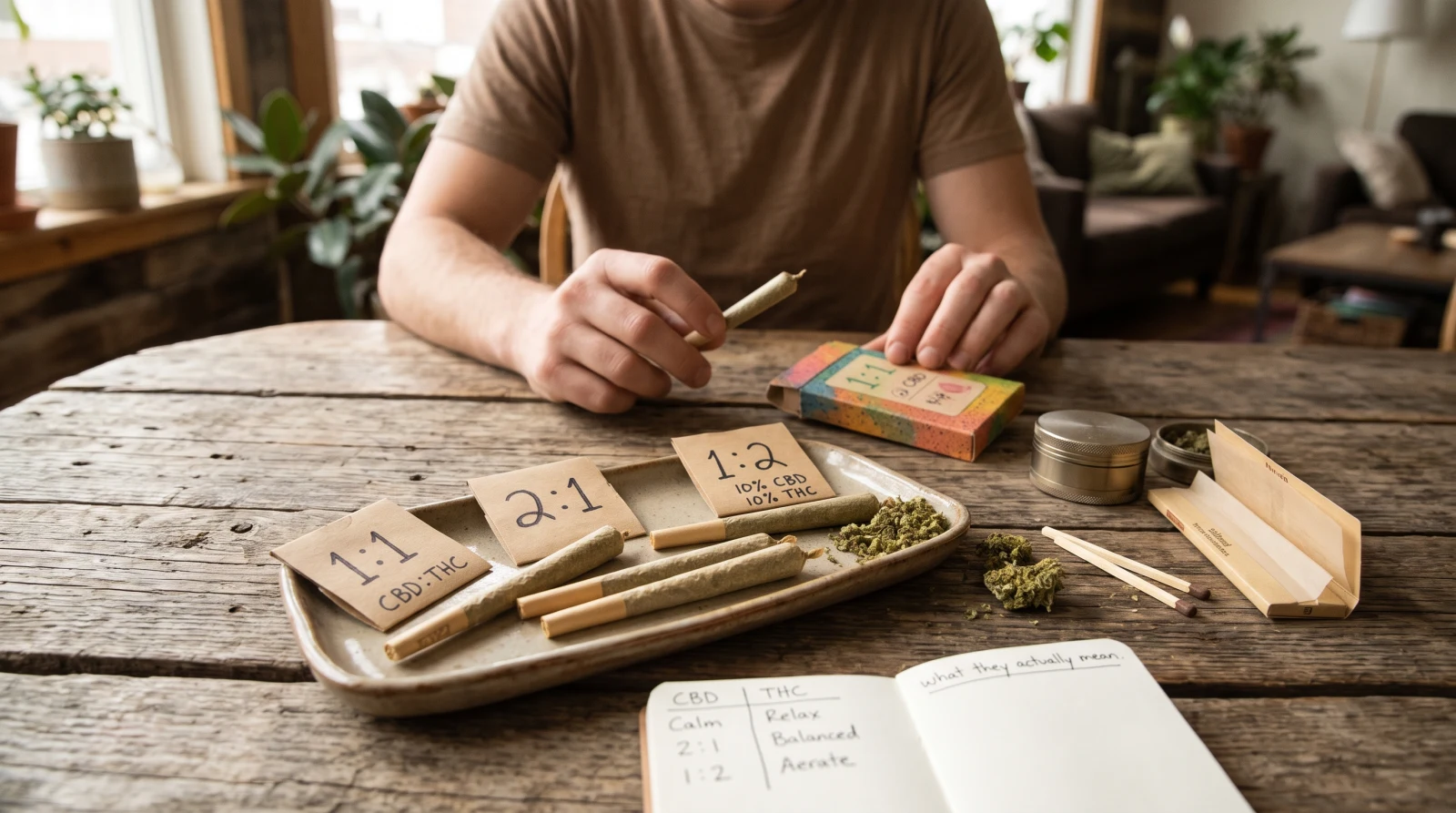
Not every cannabis joint needs to deliver the same experience. Some adults prefer products with more CBD relative to THC, while others want a more balanced ratio of both cannabinoids. Understanding the CBD ratio can help you compare pre-rolls and understand what the numbers on a product label actually mean.
A 1:1 joint and a 20:1 joint can contain very different amounts of CBD and THC, even if they look almost identical. In this guide, we'll explain common CBD ratios, how to read pre-roll labels, what affects cannabinoid amounts, and what to consider when comparing balanced joints.
In this article we explain what the common ratios mean in a real joint, who tends to like balanced pre-rolls, how their price compares with straight THC pre-rolls, and what to check before you buy.
What Makes a Pre-Roll "Balanced"
A balanced pre-roll is rolled from a flower that contains meaningful amounts of both CBD and THC. That can come from a single strain bred to produce both, or from a blend of a high-CBD strain and a high-THC strain in the same cone.
THC is the compound responsible for the high. CBD does not produce a high on its own. Some people find that a joint containing both feels milder and steadier than a THC-only joint of the same size, although the research on whether CBD actually softens THC's effects is mixed. The most reliable difference is simpler: a balanced joint usually contains less THC than a straight one, because part of the flower's cannabinoid content is CBD instead.
That makes balanced joints the opposite of infused pre-rolls and moon rocks, which add concentrate to push the THC higher.
What the Ratios Mean in Practice
Ratios are normally written as CBD:THC, but some brands reverse the order, so always check which number is which. The table shows what typical ratios can look like in a 0.5 g joint. The percentages are examples; the real figures are on each product's label.
|
Ratio (CBD:THC) |
Example label |
THC in a 0.5 g joint |
CBD in a 0.5 g joint |
What to expect |
|
20:1 (CBD-dominant) |
16% CBD, under 1% THC |
Under 5 mg |
About 80 mg |
Little to no high |
|
2:1 |
10% CBD, 5% THC |
About 25 mg |
About 50 mg |
Mild, easy to manage |
|
1:1 |
8% CBD, 8% THC |
About 40 mg |
About 40 mg |
Noticeable but moderate |
|
1:2 |
7% CBD, 14% THC |
About 70 mg |
About 35 mg |
Closer to a regular joint |
|
THC only |
25% THC |
About 125 mg |
Trace |
A standard high-THC joint |
These milligram figures are what the joint contains, not what you absorb. Smoking delivers only a fraction of it, and how much depends on how deeply and how often you inhale. The useful takeaway is the comparison: a 1:1 joint contains roughly a third of the THC of a 25% THC joint of the same weight.
Who Balanced Joints Suit
Balanced pre-rolls are a matter of preference, not a treatment, and they are not the right pick for everyone. These are the people who tend to reach for them.
Occasional smokers
If you smoke a few times a month, a full high-THC joint can be more than you want. A 2:1 or 1:1 joint lets you enjoy a whole joint without the intensity of a straight one.
Daytime and social smokers
Some adults prefer something lighter for an afternoon walk, a backyard visit or a long conversation. Lower THC makes it easier to stay in the moment, and it is the main reason balanced joints are marketed for daytime use.
Mixed-tolerance groups
When friends with very different habits share a joint, a balanced one is easier on the person who rarely smokes. The regular smoker may find it mild, but nobody ends up overwhelmed.
People cutting back
If you want to lower how much THC you take in without giving up the ritual of a joint, stepping down through 1:2 to 1:1 to 2:1 is one simple approach.
One caution applies to every ratio. A balanced joint still contains THC and can still impair you, so the usual rules hold: no driving, and no smoking before work that needs you alert.
How the Price Compares With Straight THC Pre-Rolls
Pre-roll prices mostly follow the weight and quality of the flower, not the cannabinoid ratio. Across the Canadian market, balanced and CBD pre-rolls usually sit in the same price range as THC pre-rolls of a similar size.
For a reference point, straight THC joints in our pre-rolls range start at about $4 to $5 each. A 10-pack of Drizzle Slims is $50, or $5 a joint, and five packs bring it down to $4. Infused joints cost far more, often $25 or more for a single cone.
Where balanced joints differ is the price per milligram of THC. If a 1:1 joint and a 25% THC joint cost the same, the balanced one gives you about a third of the THC for your money. For most buyers that is the point, not a drawback: you are paying for a lighter, more predictable joint, plus its CBD.
If balanced joints become your regular choice, larger packs bring the cost per joint down, and the savings from buying joints by the box apply whatever the ratio.
How to Read a Balanced Pre-Roll Label
The label tells you almost everything, as long as you read the right lines. Check these four things before you buy.
-
Both percentages. A balanced joint should list THC and CBD separately. If only THC is shown, treat it as a regular joint.
-
The order of the ratio. Confirm whether 2:1 means two parts CBD or two parts THC. The percentages settle it.
-
The weight per joint. A 1 g joint at 1:1 contains twice the THC of a 0.5 g joint at the same ratio.
-
The lab results. The certificate of analysis behind a product confirms that the CBD on the label is really there.
If you are new to a ratio, smoke part of the joint, put it out, and wait 15 minutes before deciding whether you want more. Pre-rolls relight easily, so there is no need to finish one in a single sitting.
Ordering Balanced Pre-Rolls
You must be 19 or older in Ontario, or 21 in Quebec, and government photo ID is checked on delivery. In public, adults can carry up to 30 g of dried cannabis, and Ontario's 30-gram limit counts pre-rolls by the weight of the flower inside them.


