You're comparing two strains.
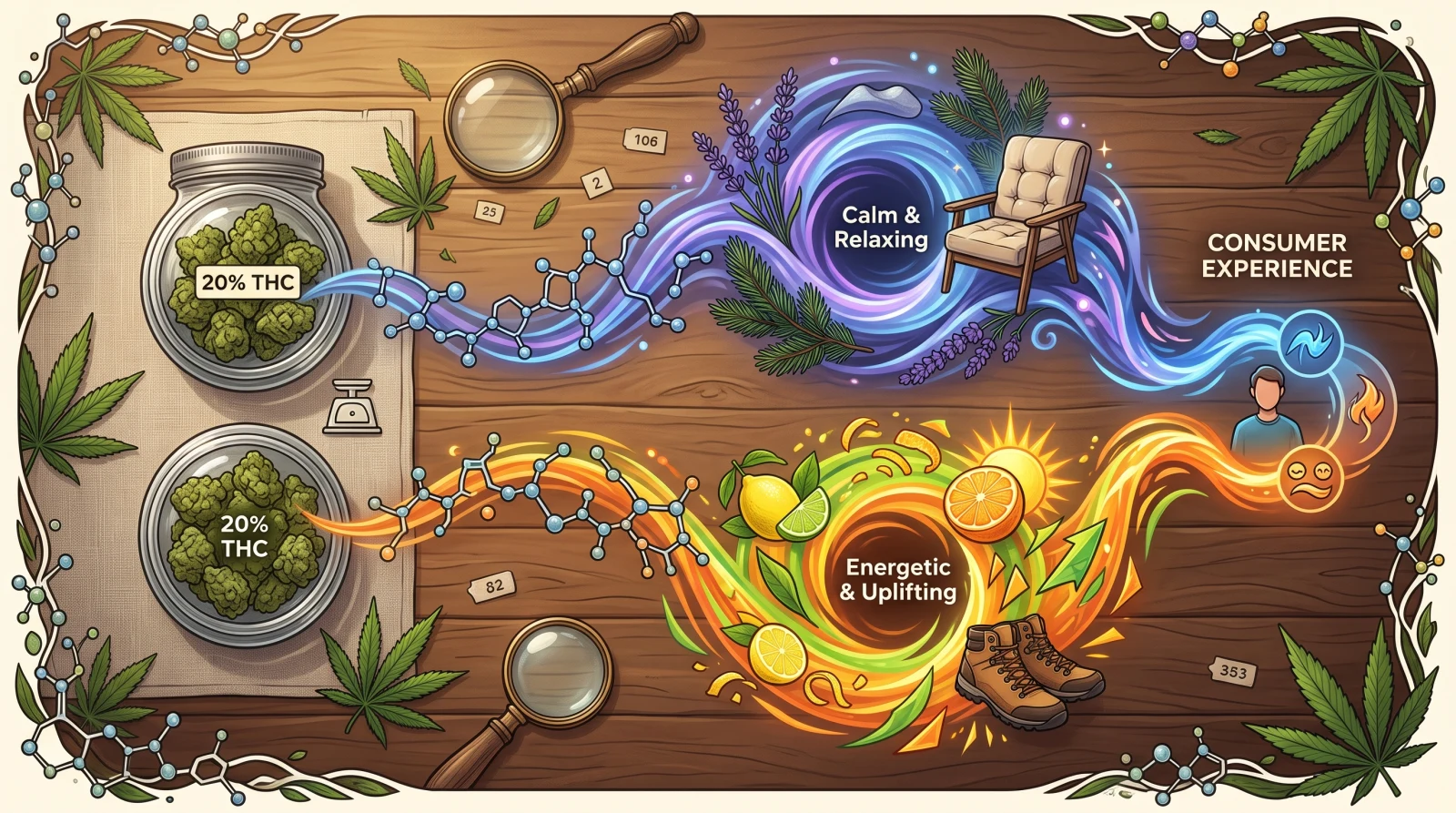
Both say 25% THC.
One smells like somebody opened a bag of lemons beside a pine tree. The other is earthy, musky, and aggressively gassy.
You try them on different nights.
The first feels bright and lively.
The second has you wondering whether getting up for the TV remote is really necessary.
Same THC.
Very different experience.
So what's going on?
Part of the answer may be terpenes — the aromatic compounds that give cannabis its huge range of smells and flavours. Myrcene, limonene, pinene, caryophyllene, and other terpenes help make one strain smell like citrus while another reminds you of earth, pepper, fruit, or diesel.
But here's where cannabis marketing gets ahead of the science.
Terpenes matter.
They just aren't little buttons labelled ENERGY, SLEEP, and CREATIVITY.
Let's break down what terpenes actually are, meet the major ones you'll see on cannabis menus, and understand why THC percentage alone can't predict exactly how a strain will hit you.
First: What Are Terpenes?
Terpenes are naturally occurring aromatic compounds found throughout the plant world.
Cannabis didn't invent them.
That sharp smell when you peel a lemon?
Terpenes.
The aroma of pine trees?
Terpenes.
Lavender?
Yep.
Cannabis produces a complicated mixture of these compounds in its resin glands alongside cannabinoids such as THC and CBD.
They're a major reason different strains can smell dramatically different even when their THC percentages look nearly identical.
Terpenes are aromatic compounds that contribute to the smell and flavour of cannabis. Different strains can contain different terpene profiles and concentrations, which is one reason two strains with similar THC percentages can provide noticeably different sensory experiences.
Think of THC as one important piece of information about the flower.
Terpenes help fill in more of the picture.
Why THC Percentage Doesn't Tell the Whole Story
THC is obviously important.
It's the primary intoxicating cannabinoid in cannabis, and the amount you consume can strongly influence the intensity of your experience.
But cannabis isn't pure THC.
Flower contains a complicated mixture of cannabinoids, terpenes, flavonoids, and other compounds.
Then you add another variable:
You.
Your tolerance matters.
Your dose matters.
How much you've eaten matters.
Your consumption method matters.
Your mood and environment can matter.
Even how tired you are can change how a session feels.
That's why this equation doesn't work particularly well:
Higher THC = automatically better weed and completely predictable effects.
A 28% strain isn't guaranteed to provide an experience you'll prefer over something testing at 22%.
And two strains both labelled 25% THC aren't necessarily going to feel interchangeable.
This is where learning basic terpene profiles becomes useful.
Not because terpenes let you predict your high with perfect accuracy.
Because they give you more information than THC alone.
Meet Myrcene: Earthy, Musky, Herbal
If you've spent any time reading cannabis descriptions, you've probably encountered myrcene.
It's commonly associated with earthy, musky, herbal, and sometimes slightly fruity aromas.
Myrcene isn't unique to cannabis. It's also found in plants such as hops, lemongrass, and mangoes.
On a cannabis menu, you'll often see myrcene mentioned alongside strains described as earthy, dank, herbal, or deeply aromatic.
Does Myrcene Make You Sleepy?
This is where things get complicated.
Cannabis culture often describes myrcene as the "relaxing terpene."
You'll even hear claims that high-myrcene strains automatically create couch-lock.
That's too confident.
Researchers are interested in how terpenes may contribute to cannabis effects, but the experience of a particular strain can't be reliably predicted from one terpene alone.
A myrcene-dominant strain isn't a guaranteed sleeping pill.
And eating a mango before smoking isn't some secret THC cheat code either.
Terpene profiles are useful clues, not guaranteed effect labels. A strain containing myrcene isn't automatically sedating, just as a strain containing limonene isn't automatically energizing.
Use myrcene primarily as information about the strain's aromatic profile, then pay attention to how you actually respond to that flower.
Limonene: Bright, Citrusy, Hard to Miss
You can probably guess this one from the name.
Limonene is strongly associated with citrus aromas.
Think lemon peel, orange rind, grapefruit, or that bright sharpness you get when citrus oils hit the air.
Limonene occurs naturally in citrus fruit and many other plants, and it also appears in numerous cannabis cultivars.
When a strain smells distinctly lemony or citrus-forward, limonene may be contributing to the profile.
Does Limonene Make Weed Energizing?
You'll often see limonene associated with uplifting, energetic, or mood-enhancing effects.
Again:
Slow down.
Those descriptions may match how some consumers experience certain limonene-rich strains, but cannabis effects aren't controlled by a single terpene.
If you personally notice that citrus-heavy strains consistently work well for daytime sessions, that's useful information.
Keep track of it.
Your own repeated experience is more useful than assuming:
Limonene = energy.
Cannabis isn't a video game where adding ten points of limonene unlocks the "productive afternoon" perk.
Pinene: Exactly What It Sounds Like
Some terpene names make you work for it.
Pinene does not.
It smells like pine.
Fresh forest.
Pine needles.
Woody, green, resinous aromas.
Pinene occurs in pine trees as well as herbs such as rosemary and basil, and different forms of pinene can appear in cannabis.
When you open a jar and get that unmistakable fresh, forest-like aroma, pinene may be part of what you're smelling.
Does Pinene Keep You Focused?
Cannabis discussions frequently associate pinene with alertness, clarity, or focus.
You'll also encounter claims that pinene somehow "cancels out" certain THC effects.
Treat those claims carefully.
Interesting research exists around terpenes and their biological activity, but turning early or limited evidence into guaranteed consumer effects is a leap.
If a pine-heavy strain feels clear-headed to you?
Great.
Remember that strain and profile.
Just don't assume every pinene-containing product will reproduce the experience perfectly.
Caryophyllene: Pepper, Spice, and a Cannabis Oddball
Crack some black pepper.
That sharp, spicy aroma?
Beta-caryophyllene is one of the compounds involved.
Caryophyllene appears in black pepper, cloves, and other plants, and it's common in cannabis.
Its aroma can be described as:
Peppery
Spicy
Woody
Warm
Sometimes it sits underneath a gassy or earthy cannabis profile and adds that nose-tingling spice you can't quite identify.
But caryophyllene is particularly interesting for another reason.
Unlike most terpenes, beta-caryophyllene can interact with CB2 cannabinoid receptors.
That makes it an unusual bridge between the terpene and cannabinoid conversations.
Does that mean a peppery strain will produce one guaranteed effect?
No.
You knew that answer was coming by now.
Linalool: Floral and Lavender-Like
If your cannabis smells surprisingly floral, linalool may be contributing.
Linalool is strongly associated with lavender and appears in numerous aromatic plants.
Its profile is often described as:
Floral
Sweet
Lavender-like
Softly spicy
Cannabis consumers frequently associate linalool-rich profiles with relaxing experiences.
But once again, the aroma is much easier to predict than the exact effect.
A strain can contain linalool alongside THC, myrcene, caryophyllene, limonene, and numerous other compounds.
You're consuming the mixture.
Not an isolated terpene.
Terpinolene: The Difficult One to Describe
Terpinolene is where simple flavour charts start struggling.
Depending on the overall profile, it can come across as:
Fresh
Floral
Herbal
Piney
Citrusy
Sometimes even slightly sweet.
It's one of those aromas where saying "it smells like terpinolene" eventually becomes easier than trying to compare it with five different plants.
You'll encounter it in various cannabis cultivars, often as part of more complex, bright aromatic profiles.
And like the others, its presence alone shouldn't be treated as an effects prescription.
One Strain Can Contain All of These
Here's the part beginners often miss.
You're rarely dealing with one terpene.
A strain isn't:
100% myrcene profile.
Or:
100% limonene profile.
It contains a mixture.
Imagine perfume.
You might notice citrus first, flowers underneath, and something woody after it settles.
Cannabis aroma can work similarly.
A strain may be dominated by myrcene but also contain meaningful amounts of caryophyllene and limonene.
Another may lead with limonene but have pinene and caryophyllene supporting it.
The relative concentrations help create the overall profile.
That's why saying "this strain contains limonene" isn't particularly descriptive on its own.
The better question is:
What's the complete terpene profile?
What About the "Entourage Effect"?
Eventually, every terpene conversation arrives here.
The entourage effect is the idea that cannabis compounds may interact in ways that influence the overall experience rather than acting completely independently.
It sounds intuitive.
Cannabis contains numerous cannabinoids and aromatic compounds, so researchers have naturally investigated whether combinations matter.
But the term gets abused in marketing.
You'll sometimes see incredibly precise claims:
This exact combination of limonene and pinene produces creativity.
That's not how confidently we can interpret the evidence.
The possibility of interactions between cannabis compounds is scientifically interesting.
The ability to predict a person's exact experience from a terpene label is much less established.
Keep the distinction.
It'll save you from a lot of cannabis marketing nonsense.
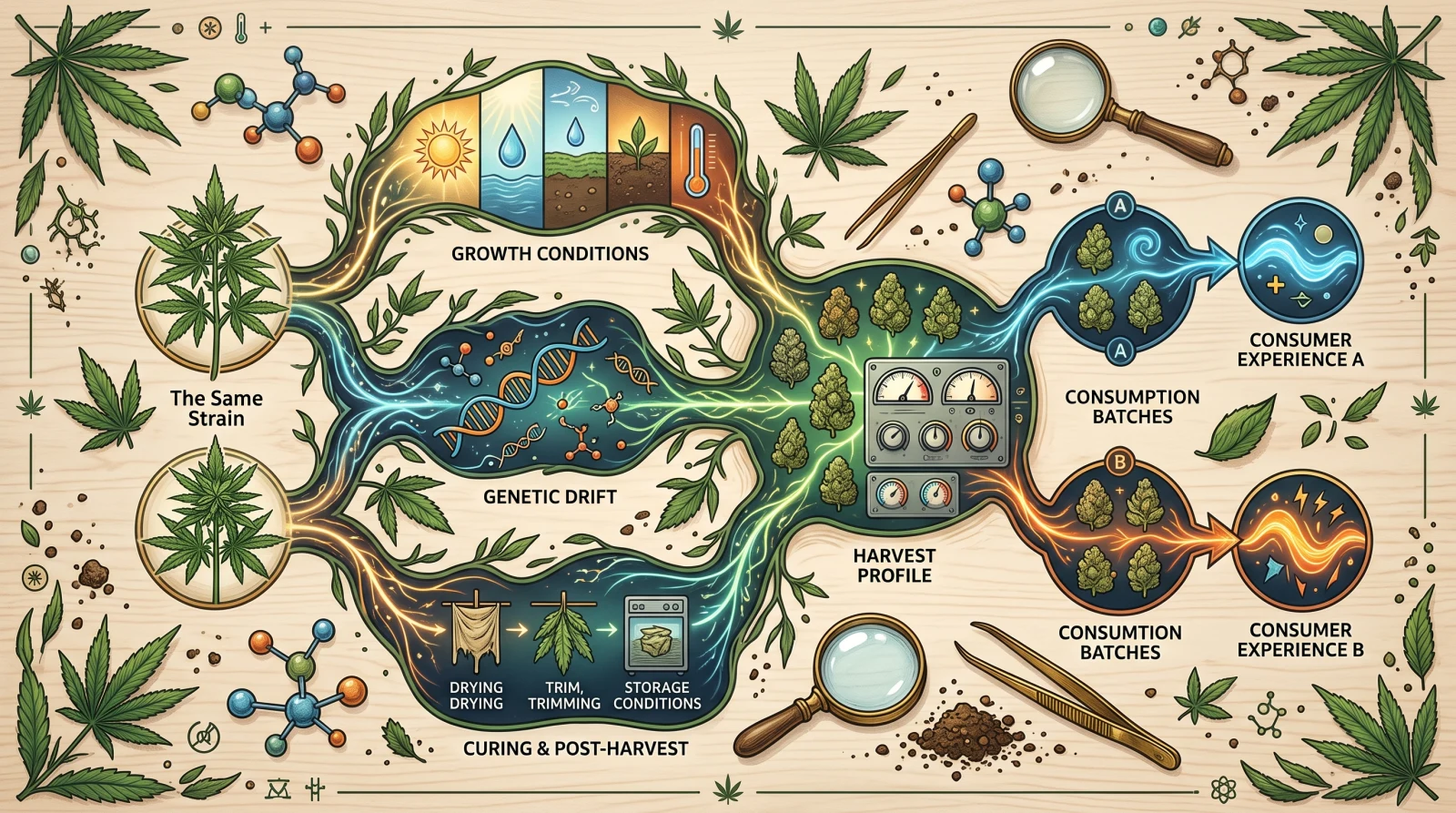
Why the Same Strain Can Have Different Terpenes Between Batches
Here's another complication.
You find a strain with a terpene profile you love.
You buy it again two months later.
It smells different.
That's possible.
Cannabis is an agricultural product, and terpene concentrations can be influenced by genetics, phenotype, growing conditions, harvest timing, drying, curing, storage, and age.
Even the same cultivar isn't guaranteed to produce chemically identical flower every harvest.
A batch may express more of one terpene than another.
The cure may preserve aroma better.
One batch may simply be fresher.
That's why strain names are useful, but batch information is better.
Does Smell Tell You Anything About Terpenes?
Absolutely.
Your nose is actually useful here.
If flower smells strongly of citrus, pine, pepper, earth, flowers, or fruit, you're detecting volatile aromatic compounds.
You probably can't accurately identify every terpene concentration by smell alone.
Neither can the guy at the party who insists he can smell exactly 0.63% caryophyllene.
But you can develop preferences.
Maybe you consistently enjoy citrus-forward flower.
Maybe gas and earth are your thing.
Maybe pine-heavy strains keep appearing among your favourites.
That pattern is valuable.
You don't need a chemistry degree.
You need to pay attention.
How to Actually Use Terpenes When Buying Weed
Don't replace THC obsession with terpene obsession.
That's missing the point.
Use terpenes as another layer of information.
Start with what you already know.
Remember What You Enjoyed
When you find a strain you really like, don't only remember its name.
Remember the aroma.
Was it citrusy?
Gassy?
Earthy?
Peppery?
Piney?
Sweet?
Then check its terpene information when available.
Patterns may start appearing after several strains.
Compare Similar THC Products
This is where terpene information becomes especially interesting.
If you're choosing between two strains with similar THC levels, their aroma and terpene profiles can give you another way to differentiate them.
Instead of:
25% vs 25%. Guess I'll flip a coin.
You now have more information.
Don't Chase One Terpene
Finding out that you liked a myrcene-heavy strain doesn't mean you should spend the rest of your life hunting myrcene.
You liked that strain.
Its full chemical profile, dose, freshness, cure, and your own response all contributed.
Look for patterns across multiple experiences.
Trust Your Nose
If you're choosing flower and one option has an aroma you genuinely love, that matters.
Cannabis is a sensory product.
You're allowed to care about how it smells and tastes.
THC isn't the only number allowed to influence your purchase.
Can Terpenes Tell You Whether a Strain Is Indica or Sativa?
Not reliably.
Traditional labels like indica, sativa, and hybrid remain useful ways consumers navigate cannabis menus, but they don't provide a complete chemical profile.
Two products labelled indica can have different cannabinoid and terpene compositions.
Two sativas can smell completely different.
A hybrid can lean toward almost any flavour family.
This is another reason judging cannabis entirely from one label tends to oversimplify things.
"Indica."
"28% THC."
"High limonene."
Each tells you something.
None tells you everything.
Terpenes Can Disappear When Weed Is Stored Badly
Terpenes are volatile.
That's part of why you can smell them so easily.
It's also why storage matters.
Heat, light, oxygen, excessive dryness, and time can degrade the aromatic quality of cannabis.
You might buy flower that originally had a beautiful terpene profile but encounter it months later after poor storage and wonder where the smell went.
It didn't become a different strain.
Some of the aromatic compounds simply didn't stick around forever.
Terpene-rich flower still needs proper storage. Keep cannabis sealed appropriately and away from excessive heat and direct light. A great terpene profile can't help much if poor storage leaves the flower dry and nearly scentless.
Freshness matters just as much as a fancy terpene chart.
The Beginner Terpene Cheat Sheet
If you're new to all of this, don't memorize twenty compounds.
Start here:
Myrcene
Think: earthy, musky, herbal.
Limonene
Think: lemon, orange, bright citrus.
Pinene
Think: pine needles, forest, fresh herbs.
Caryophyllene
Think: black pepper, spice, wood.
Linalool
Think: lavender, flowers, soft sweetness.
Terpinolene
Think: fresh, herbal, floral, piney, citrusy.
That's enough.
Seriously.
You don't need flash cards.
Start smelling your flower before you grind it and pay attention to which profiles keep showing up in strains you enjoy.
You'll learn more from repeated experience than from trying to memorize every terpene on Wikipedia.
Frequently Asked Questions
Terpenes are naturally occurring aromatic compounds that contribute to the smell and flavour of cannabis. They're also found throughout the plant world, including citrus fruits, pine trees, lavender, herbs, and spices.
THC percentage is only one part of a cannabis product. Different strains can have different terpene profiles, minor cannabinoids, genetics, and other chemical characteristics. Dose, tolerance, freshness, consumption method, mood, and individual biology can also change the experience.
Myrcene is a terpene commonly associated with earthy, musky, and herbal aromas. It's frequently marketed as relaxing or sedating, but the presence of myrcene alone can't reliably predict exactly how a cannabis strain will affect an individual.
Limonene contributes citrus-like aromas such as lemon and orange. Although cannabis marketing often associates it with uplifting effects, a strain's actual experience depends on its broader chemical profile, dose, and the individual consuming it.
Pinene is strongly associated with fresh pine and forest-like aromas. It occurs naturally in pine trees and numerous other plants as well as cannabis.
Terpenes can be useful when comparing aroma and flavour profiles and identifying patterns among strains you've enjoyed before. However, they shouldn't be treated as guaranteed predictors of effects. Consider them alongside potency, cannabinoids, freshness, dose, and your own previous experience.
The entourage effect is the idea that different compounds in cannabis may interact and influence the overall experience. It's an active area of scientific interest, but many precise effect claims used in cannabis marketing go beyond what current evidence can confidently predict.
The Bottom Line on Cannabis Terpenes
Terpenes make cannabis considerably more interesting than a THC percentage.
Myrcene brings earthy and musky aromas.
Limonene brings citrus.
Pinene brings the forest.
Caryophyllene brings pepper and spice.
Linalool brings floral notes.
And those compounds combine in different concentrations to help create the enormous range of aromas and flavours found across cannabis strains.
Can terpenes influence the overall cannabis experience?
They're certainly part of the chemical picture, and researchers continue studying exactly how cannabis compounds interact.
But don't turn that into something the science can't promise.
Myrcene doesn't guarantee couch-lock.
Limonene doesn't guarantee energy.
Pinene doesn't guarantee focus.
Cannabis is more complicated than that.
So next time you're comparing two strains with the same THC percentage, don't assume they're basically identical.
Smell them.
Look at their broader profiles.
Remember what you've enjoyed before.
And pay attention to how your own body responds.
Because THC tells you part of the story.
Terpenes help explain why the rest of the story can smell, taste, and feel completely different.